
The Digital transformation It is no longer an option in industrial companies: it is a necessity. In this context, lArtificial Intelligence is becoming a key tool for optimizing internal processes, Especially in critical areas such as onboarding, training and professional development. The onboarding of new workers into complex industrial environments poses multiple challenges: linguistic barriers, cultural diversity, demanding technical protocols, Need for rapid adaptation and Regulatory compliance. Traditionally, these processes have required a high investment in human resources, time, and training materials, without always ensuring a homogeneous or personalized experience. Generative AI changes this paradigm. Thanks to Intelligent conversational assistants, It is possible to offer continuous, accessible and personalized training adapted to the language, profile and pace of each worker. These systems not only resolve doubts in real time but also accompany, guide and evaluate learning, improving integration and reducing friction in the first months of onboarding. A prominent example of this application of AI tutors at the industrial level is NAIMA, a solution developed to facilitate onboarding and training in industrial environments. A conversational assistant with a 3D avatar, multilingual support, and automated training features. The NAIMA project demonstrates how AI can go from being an emerging technology to becoming a real operational tool within the company.
AI assistants and tutors in the enterprise: what they are and what benefits they bring
When we talk about AI assistants or tutors in corporate environments, we are referring to advanced conversational systems based on generative artificial intelligence, capable of interacting naturally with employees via voice or text, providing training, technical and operational support. These are not simply traditional chatbots with predefined answers. We are talking about solutions that:
- Understand the user's context and profile.
- Adapt the information to the worker's level of knowledge.
- Integrate structured training content.
- Assess learning through quizzes or interactive dynamics.
- Work in both online and offline environments.
Key benefits of AI tutors for businesses
- More agile, scalable onboarding: They can support multiple workers simultaneously, reducing the load on the training team and ensuring a consistent message.
- Personalized, continuous training: Each worker can learn at their own pace, ask questions at any time and reinforce specific content according to their needs.
- Reduced language and cultural barriers: Multilingual support makes it easier to integrate international profiles, something especially relevant in globalized industrial sectors.
- 24/7 availability and operational support: AI assistants can act as a permanent point of reference for procedures, safety or internal protocols.
- Measuring and improving learning: Integrating automated assessments makes it possible to validate knowledge and identify areas for improvement.
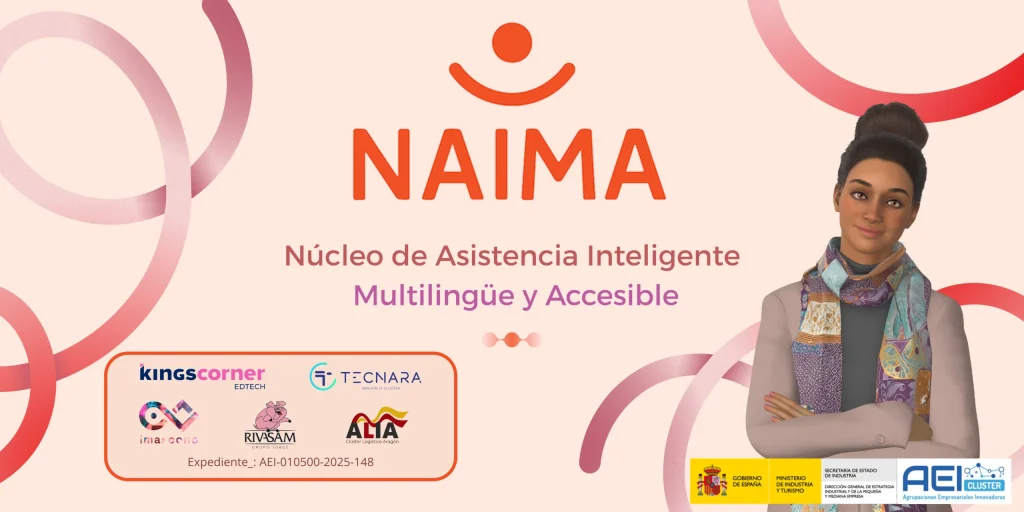
NAIMA: a real-world case of AI applied to industrial environments
In this context, the NAIMA project represents a success story in the practical application of AI to onboarding and professional training in industrial environments. It is an initiative driven collaboratively by Tecnara, ALIA, EdTech, Imascono and Rivasam and funded by the Spanish Ministry of Industry and Tourism within the AEI support program, aimed at helping to improve the competitiveness of small and medium-sized enterprises. The grant awarded to the project has a total budget of €237,878. NAIMA is a multilingual, accessible conversational solution based on generative AI, designed specifically to train, guide and support workers as they join industrial environments.
Project objectives
The development of NAIMA pursues very clear strategic objectives:
- Facilitate onboarding and accessible training in the workers' main languages.
- Reduce cultural barriers and improve integration.
- Provide technical, training and operational support tailored to the industrial environment.
- Validate the solution in real use cases through web and physical demonstrators.
In short, NAIMA is not just a conversational assistant: it is a digital tutor designed to support workers from day one, improving their experience, accelerating their integration and ensuring more effective, consistent training. Want to learn more about the project or about the use of AI in industrial training? Contact the Imascono team and together we will explore all the possibilities offered by Artificial Intelligence in your company's onboarding.