A family-owned digital metal holding company digitized its business and technical processes step by step. Its goal was clear: that the knowledge of its most veteran professionals would not be lost with retirement.
At Imascono, we accompany companies on their journey towards the future, step by step and with each client. Today we want to share a real case: that of an industrial company that decided to change its way of working and which we accompanied throughout the entire process.
A knowledge that was only in the minds of two or three people
It is a family-run industrial holding company dedicated to the processing of metal and steel, which manufactures parts and structures for sectors as demanding as automotive and logistics. It was founded by a generation that built everything from scratch, and today it is run by the second generation, who has inherited the machines, the customers, and also a way of working that has been delivering good results for decades. Nevertheless, the management was thinking about the future of the company. factory And I knew that I had challenges ahead of me.
When we got to know their day-to-day operations, we found something common in many industrial SMEs. The most valuable knowledge of the company was not in any system, but in the experience of a few people.
The commercial offers were often prepared without drawing the piece in 3D, using a spreadsheet and the experience of someone who had been calculating time and materials for thirty years. It worked because that person was there, but he was approaching retirement. Moreover, once the order was confirmed, the technical office designed the 3D piece without connection to the management system. All the information was transferred by hand, with duplicated work and the risk of errors in materials, times, cutting lists and plans that this entails.
Three doubts before starting
The first reaction to the idea of digitizing was cautious. The cost was a concern, understood also as the cost of stopping something that works every day for a little while. It was also a concern about who would maintain the new tools and who would have to learn to use them. And, above all, it was worrying whether the technology would eventually replace the technicians and the shop foreman of all those years.
Our response was the same as always: it's not about adding more Technology, Rather, it is about incorporating the appropriate one for each challenge and at the right time.
From manual to intelligent, step by step
To analyze digital maturity At a company we work with a graphic designer who goes through four stages: manual, connected, intelligent, and autonomous. We apply it on a general level and also for departments and processes, so that each change is measured, analyzed, and adjusted before taking the next step.
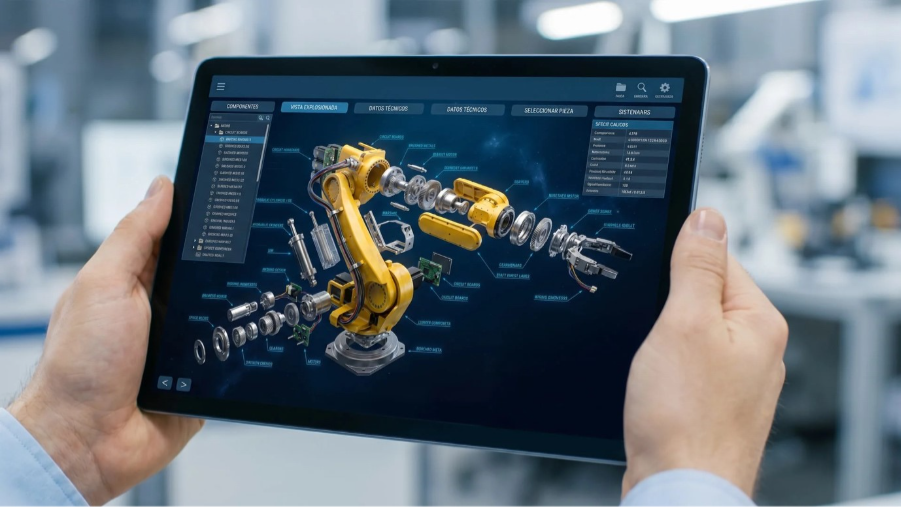
This company started with a manual process. The first advance was to connect the systems, and it came in two ways: a tool that compares each new offer with previous projects, and an integration between 3D design and ERP that automates materials, drawings, and production times.
With the data already connected, the company has begun to move up the smart ladder, where information helps to make decisions. It allows for more accurate estimations, maintaining the traceability of the entire process and comparing production alternatives. The next goal is a system capable of simulating and proposing the most efficient options, always leaving the final decision in the hands of the people.

Digitizing is also preparing for the generational shift
Many industrial companies are experiencing a double tension. On the one hand, they are not finding replacements for their more experienced employees, who are retiring with knowledge that no one has had time to inherit. On the other hand, there are young people who do want to enter the sector, but who find it difficult to imagine working with spreadsheets from thirty years ago or constantly asking their colleague next to them.
Digitizing the process allowed that knowledge to be turned into a tool accessible to the entire team. The veteran professionals no longer served as the sole support for the process; their experience was documented and available. The goal was never to replace the people, but to preserve what they know, facilitate the transition, and make the process more attractive. I work in the industry.
How to implement AI in the day-to-day operations of a business
When a company asks us how to apply Artificial intelligence, He almost never asks about the technology itself. He wants to know how much it will cost, how his staff will adapt, and who will support him once the solution is implemented.
Our experience tells us that the answer almost never comes from automate everything, It is normal for it to work better when identifying two or three very specific pain points, with a clear responsible person within the company, and resolving them one by one with a development plan visible from the beginning. In this way, the project ceases to be an abstract promise and becomes a path with recognizable stages, where each one justifies its own cost.
The company behind this story remains a family business, with its essence, its workshop and its second generation at the helm. What has changed is that they no longer have to cross their fingers every time a key member leaves on vacation or retires.