Metaverse: What is it and how does it work?
The term "metaverse" was coined by Neal Stephenson in his 1992 science fiction novel called "Snow Crash" . In the book, the Metaverse is described as a virtual space in which users can interacting through avatars in a shared digital world . The word "metaverse" combines the prefix "meta-", which means "beyond" or "transcendent" and "verse", which refers to a universe or world. Therefore, the term "metaverse" would be something like. a world beyond the physical universe The "Virtual Space", a virtual space that exists in parallel and allows the interaction and participation of people through digital technologies. In addition to avatars, in these virtual spaces the following are used NFTs (Non Fungible Tokens) and cryptocurrencies . These spaces are both 3D recreations of real places and imaginary creations. Through text, voice or video chat, users interact with each other, participating in shared activities and experiences. As the interest in virtual worlds and the Virtual Reality has grown, the term "metaverse" has been adopted by various industries and the media to describe the concept of a shared and evolving virtual space that goes beyond Virtual Reality experiences and has the potential to become an integral part of people's daily lives. The Metaverse is positioning itself as an important technological trend and a digital space that is expected to commerce, entertainment, leisure, culture and business to relocate in the next few years.
What are the characteristics of the Metaverse
The characteristics of the Metaverse may vary according to the different visions and definitions proposed. However, here are some common characteristics associated with the Metaverse concept:
- Espacio virtual compartido: El Metaverso es un espacio digital en el que múltiples usuarios pueden interactuar entre sí y con objetos digitales en tiempo real. Es un entorno compartido donde las personas pueden conectarse, comunicarse y colaborar.
- Inmersión y presencia: El Metaverso busca ofrecer una experiencia inmersiva, permitiendo a los usuarios sumergirse en entornos virtuales y sentirse presentes en ellos. Utiliza tecnologías como la Realidad Virtual y la Realidad Aumentada para lograr una mayor sensación de presencia en el entorno digital.
- Interactividad y participación: Los usuarios del Metaverso tienen la capacidad de interactuar entre sí y con el entorno virtual. Pueden comunicarse a través de chat, voz o video, explorar entornos, realizar acciones y participar en actividades virtuales.
- Permanencia y evolución: El Metaverso es un espacio digital en constante evolución. Los objetos, construcciones y cambios realizados por los usuarios pueden permanecer en el tiempo, lo que significa que el Metaverso puede cambiar y desarrollarse incluso cuando los usuarios no están presentes.
- Escala y diversidad: El Metaverso tiene el potencial de ser un entorno digital vasto y diverso. Puede incluir una amplia gama de entornos, desde recreaciones de lugares del mundo real hasta mundos imaginarios, y puede albergar diversas comunidades, actividades y experiencias.
- Interoperabilidad: El Metaverso se basa en la interoperabilidad, lo que implica que los usuarios puedan transferir bienes y datos entre diferentes plataformas y entornos virtuales. Esto permite una mayor conectividad y una mayor fluidez en la experiencia del Metaverso.
It is important to keep in mind that the concept of "metaverse" is constantly evolving and there is no single, definitive definition. The characteristics may evolve as new technologies are explored and more sophisticated platforms and virtual environments are developed.
Opportunities offered by the Metaverse
The Metaverse offers a wide range of opportunities in different aspects. Here are some of the most outstanding opportunities associated with the Metaverse:
Social interaction and collaboration
The Metaverse provides a virtual space for people to interact and collaborate with each other, regardless of their geographic location. It enables connection with friends, family, colleagues and even strangers, expanding opportunities for online socialization and collaboration.
Virtual commerce and economy
The Metaverse offers opportunities for virtual commerce and virtual economy. Users can buy and sell digital goods and services, create and manage virtual businesses and even participate in cryptocurrency-based economies. This opens up new possibilities for entrepreneurship and income generation in the digital environment.
Education and immersive learning
The Metaverse has the potential to revolutionize education and learning. It can provide immersive, interactive environments where students can explore complex concepts, engage in realistic simulations, and collaborate with peers and teachers from around the world.
Entertainment and virtual experiences
The Metaverse offers a variety of entertainment opportunities and virtual experiences. Users can enjoy online games, attend virtual concerts, visit virtual museums and art galleries, watch movies, and participate in unique events and recreational activities that are only possible in the digital environment.
Innovation and creativity
The Metaverse fosters innovation and creativity by providing a flexible space for experimentation and digital content creation. Users can design and build virtual environments, create custom avatars, develop interactive applications and experiences, and explore new forms of artistic expression.
Access to information and knowledge
The Metaverse can facilitate access to information and knowledge in a variety of areas. Users can access digital libraries, educational resources, historical archives and databases, opening up opportunities for research, lifelong learning and information dissemination. These are just a few of the opportunities that the Metaverse can offer. As the technology and adoption of the Metaverse continues to evolve, new and exciting opportunities are likely to emerge in a variety of fields.
Metaverse and Web3 applications
Metaverse and Web3 applications can be extended to all types of industries.
1. Application in the Industry 4.0 Sector
Web Applications focused on the most business-oriented sectors adapt to all the needs of management and communication both internal and external to the companies. These applications provide access to a proprietary interface from any device and web browser. A fact that facilitates collaboration and information exchange between departments, by being able to work together in the different projects directly online and instantly displaying all updates.
Externally, WebApps give all users access to a wide range of content that, regardless of their devices, is instantly adapted to their needs as they interact with the elements .
2. Application in the education sector
In the education of future generations, the Metaverse not only allows the development of more immersive and interactive experiences. It also makes it possible to recreate environments and even virtual campuses that, in an active and personalized way, nurture the curiosity and involvement of the students. Thanks to the innovations of the Extended Reality teachers can enrich and deepen the learning programs, being able to teach with support from holograms, with interactive 3D models and becoming guides for these digital natives through different 3D worlds dedicated to science, history, nature... Technological solutions to enjoy the subjects as we had never imagined. One of the educational programs that has already been launched is the 3D virtual space web of Learning to undertake developed together with Fundación Ibercaja to bring the world of business to schoolchildren in a gamified environment close to video games.
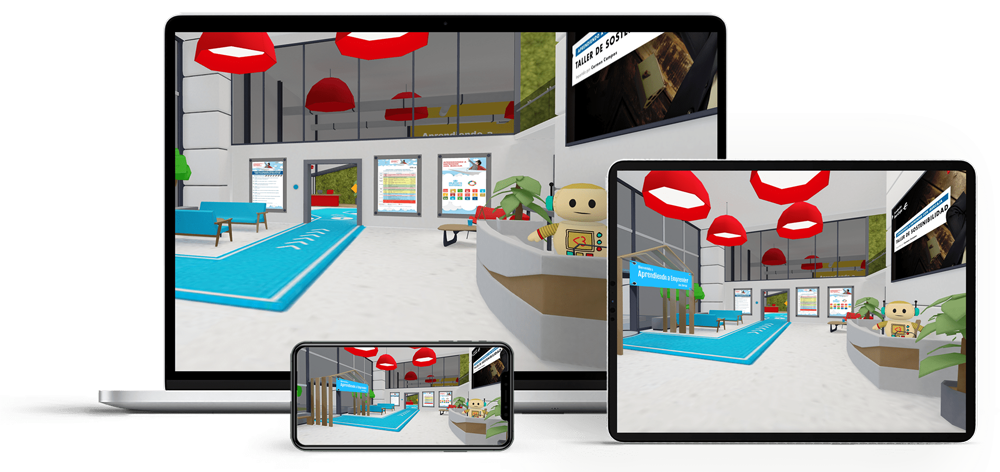
Espacio Virtual 3D desarrollado para Ibercaja
3. Aplicación en el sector del retail
There is no doubt that the Metaverse will be the next evolution of the already widespread and implemented e-commerce. Where web pages will become large virtual spaces where physical stores are recreated or even their own universes with unique experiences in which to explore all the possibilities of brand loyalty. What is a fact is that the shopping experience will once again put consumers at the center of the experience with more accessible, intuitive and humanized processes .
The possibilities of this new technology in retail range from the ultimate hybridization between physical and digital in omnichannel shopping, to the development of new value propositions. Virtual Reality gateways, Augmented Reality-based fitting rooms, the creation of new business models with phygital collections (proposals for both the real and virtual world) or garments/products created exclusively for the Metaverse such as NFTs (digital objects) for our avatars. Among the proposals that have already seen the light of day are the interactive house of the cookware brand Lèkuè . A virtual space where you can see all the products in action and get to know them first hand.
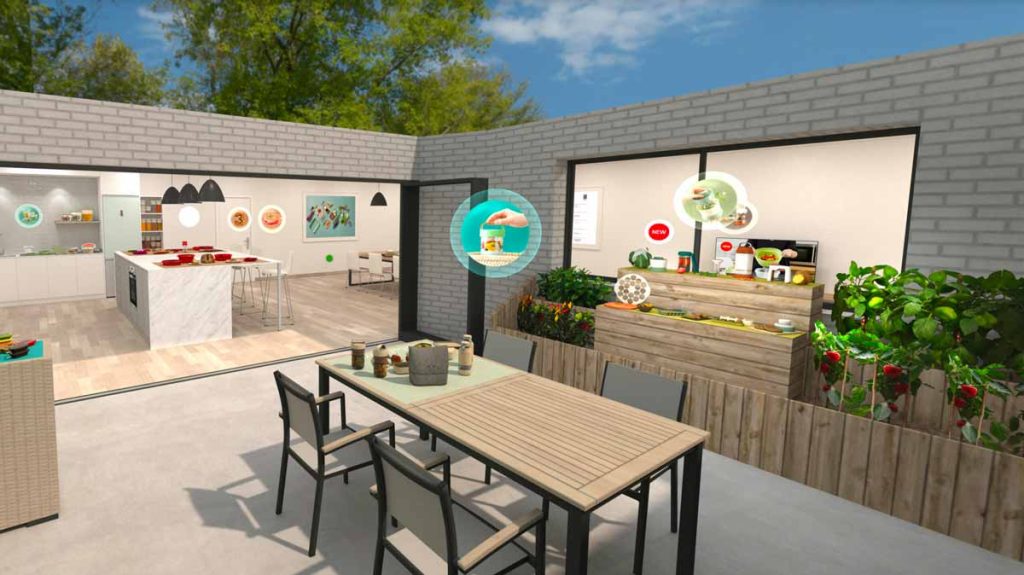
Espacio Virtual diseñado para la marca Lékué con productos 3D interactivos
4. Marketing and advertising applications
If there is a sector that advances almost at the same time as technological innovation, it is the marketing and advertising sector. Keeping abreast of trends and the continuous search for new new ways to attract users mark the starting point for the implementation of this new virtual dimension for the positioning and loyalty of consumers.
Thanks to the development of spaces close to the video games In this way, brands not only get closer to the new ecosystems of younger audiences, but can also create truly immersive and personalized experiences. One of the recent implementations by Imascono (Business2Metaverse), has been on the Rafa Nadal Academy by Movistar Metaverso where we found a 3D recreation of the sports facilities that have an exceptional guide, the avatar of Rafa Nadal himself.

Espacio Virtual interactivo realizado para promover la Rafa Nadal Academy by Movistar
5. Applications in the tourism and cultural sector
The possibility of create new experiences that are different, accessible and personalized will also make tourism and hospitality one of the sectors that most implement the Metaverse among its activities. From virtual receptions that facilitate the booking of stays and virtual tours to discover unimaginable places to enjoy interactive museums and know the best routes in real time through Augmented Reality maps.
Gracias a las tecnologías de la Realidad Extendida podemos visitar las salas de los grandes museos de todo el mundo e incluso se pueden organizar viajes en el tiempo, para vivir en primera persona la historia de un monumentos o una ciudad a lo largo de los siglos. Si hay un proyecto que muestra el gran potencial de estas tecnologías es el Metaverso de la ciudad de Zaragoza recreando en 3D la experiencia de la tradicional Flower Offering durante las Fiestas del Pilar. Una acción turística que ha alcanzado a 32.000.000 millones de personas con más de 350.000 usuarios únicos.
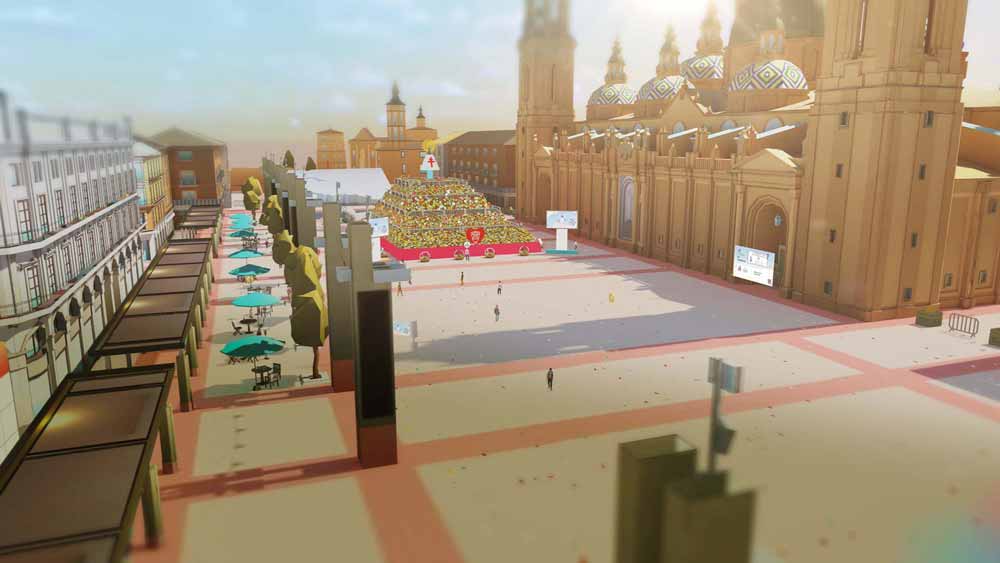
Metaverse of the city of Zaragoza recreating in 3D the experience of the traditional Offering of Flowers
6. Aplicaciones en el sector del entretenimiento
The Metaverse will change the way we interact, socialize and, above all, enjoy our free time. At a time when there are so many options to entertain us, the digital audience is opting for more novel and attractive experiences.
For example, experience matches and sporting events as if we were on the field through Virtual Reality glasses. From immersing ourselves in the stories and the fictitious universe of series and short films at Virtual Reality The world of our favorite movies, see the action scenes from all angles, feel part of the cast by watching in first person behind the scenes. Thanks to virtual glasses we will be able to enjoy attractions that take the experience and adrenaline to another level or be part of massive concerts in the comfort of our homes. In addition, videogames will gain in mobility and interactions sharing adventures and missions with friends, family and even players from other parts of the planet in a much more natural way. Leaving behind the controllers and flat screens that we all know.
7. Aplicaciones en el sector sanitario
The implementation of Extended Reality technologies in the healthcare field covers a wide range of activities. From the development of more accessible and intuitive information and consultation areas for all audiences, with special attention to the elderly. A la creation of simulations and customized virtual therapies The company is taking advantage of the capacity of these technologies to work in controlled virtual environments.
In addition, Extended Reality offers the most advanced tools and experiences for the medical and health training . In addition to making available to professionals all the information on the procedures and constants of the patients thanks to the implementation of augmented reality glasses during the interventions and the most advanced virtual reality glasses for the remote operations The first of its kind: unprecedented breakthroughs that will revolutionize global medicine. One example that is already being seen in reality is the virtual 3D recreation of the San Juan de Dios Hospital where all patients/users can know in detail the health center, its services and facilities in a more accessible and intuitive way than static web pages.
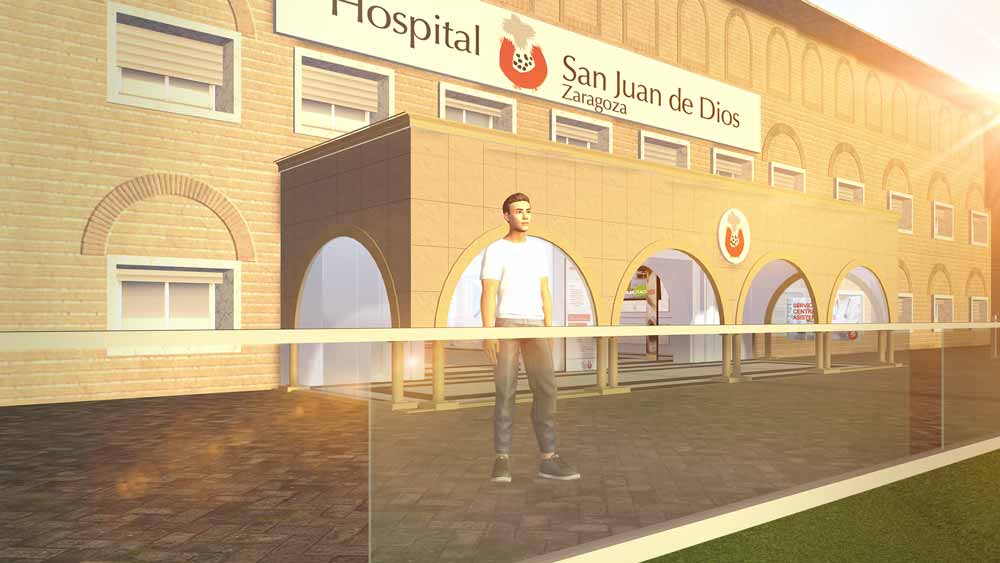
8. Applications in the banking sector
La banca es otro de los sectores empresariales que más se va a transformar con la llegada de las tecnologías del Metaverso. No solo por la irrupción de las criptomonedas (monedas digitales) que van a cambiar las transacciones a nivel internacional, sino también por la entrada de los propios usuarios a este mundo virtual. Estas monedas serán una parte importante de las New interactions en el Metaverso: el dinero virtual para gastar en los espacios virtuales (para comprar productos para los dos mundos: el real y el virtual). En este nuevo ecosistema económico, los bancos e instituciones financieras deben liderar el cambio con nuevos espacios, formaciones y servicios personalizados para que el componente humano y relacional no se pierda en la economía del Metaverso.

The future of the Metaverse: will it ever be real?
The correct question would be whether the concept of a single interconnected and decentralized virtual universe will become completely real. It is difficult to answer with certainty, as it depends on several factors, including the advancement of technology, mass adoption and the creation of a single common platform for all the virtual worlds that are already beginning to develop. Currently, there are different companies and projects where we are working on the development of technologies and platforms related to the Metaverse. Renowned companies, such as Facebook's Meta Platforms, Microsoft, Apple and other large international technology companies, have expressed their interest and have begun to invest resources in this area. Although the creation of a single common platform for all the virtual worlds that are already beginning to be developed has not yet been developed, the following are in progress significant advances in terms of Virtual Reality, Augmented Reality, Artificial Intelligence and 5G connectivity technologies. which are key elements to make the Metaverse possible. We are now beginning to see initial versions of the Metaverse, but with time and technological evolution, it is possible that the Metaverse will become more sophisticated and accessible to an increasing number of people. It is important to keep in mind that the Metaverse will not become a reality overnight. It will be a gradual process that will require the development of standards, regulations and overcoming technical, ethical and privacy challenges.
Do you need your project to be in the Metaverse? Contact us. At Imascono we can help you to transfer your project to the Metaverse .