
AI and virtual reality complement each other: Virtual Reality creates the immersive environment and Artificial Intelligence makes it intelligent. Thanks to AI, the characters speak without a script, the space reacts to the user’s gaze, gestures, and voice, and the experience adapts to each person in real time.
A concrete example: at the Aquarium of Zaragoza, we developed a visit with Apple Vision Pro in which a hyperrealistic avatar with generative AI acts as a guide and answers live questions from each visitor. In just one month, the experience increased visits by 20% and tripled user satisfaction.
This union is part of a broader evolution, along with the Virtual Spaces and the Spatial Computing. Below we explain how artificial intelligence and virtual reality are combined, what AI does within a virtual environment, and in which sectors it is already being applied.
How do Artificial Intelligence and Virtual Reality combine?
The Virtual Reality It immerses us in a completely digital 3D environment, usually through glasses, to create the feeling of being in another place. Artificial intelligence Don't create that environment, but endow your elements with the ability to understand the user and react intelligently to what they do. If you want to review each technology separately, we'll tell you about it in What is immersive virtual reality? and in Types of AI.
The relationship between virtual reality and artificial intelligence is based on their mutual enhancement. AI can significantly improve the experience, through virtual space services for companies, By making it more flexible, adaptive, and personalized to the behavior of each user.

How does AI operate in a Virtual Reality environment?
Within a Virtual Reality experience, AI works on several layers at once: it brings characters to life, interprets what the user does, helps the glasses perform better, and adapts the space itself. These are the five main mechanisms.
Autonomous avatars
They are intelligent characters who talk and react on their own, without a closed set of responses. Instead of repeating programmed phrases, they understand the question, take into account the context, and respond naturally, with voice and gestures. That is what they do. VEGA, our hyperrealistic avatar with Generative AI, and the same technology that lies behind the AI agents for companies.
Interaction without controls with Eye & Hand Tracking
The cameras and sensors in the glasses track the gaze and hand movements, and the AI models interpret that data: what you’re looking at, what gesture you’re making, and what you want to do with it. This way you can select an object with your gaze and activate it by pinching together your fingers, without physical controls.
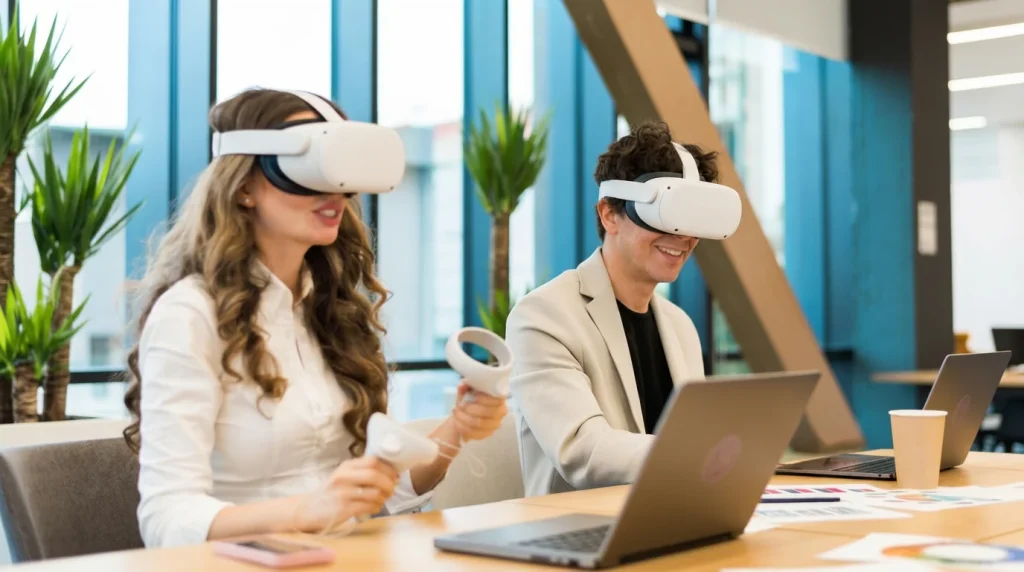
Smart or foveated rendering (Foveated Rendering)
The human eye can only see very small areas clearly, right where it focuses its gaze. Foveal rendering takes advantage of that limitation: thanks to eye tracking, the glasses show maximum quality at the point you’re looking at and reduce resolution at the periphery, where you don’t notice it. The result is more visual quality with less load on the system. Devices like Apple Vision Pro or PlayStation VR2 already incorporate it.
Generation of real-time environments
AI can modify the virtual space as you move through it, based on your decisions. In a training session, the scenario changes depending on how the student resolves each situation. In architecture and interior design, the client can enter the Digital Twin of your future home and change the layout, colors or furniture live on the spot.
Voice recognition and gestures
The user gives commands using voice or gestures within the own environment, without menus or buttons. The AI transcribes what they say, understands the intention and executes the action: opening a door, showing a tab or asking for help from the avatar. At the Aquarium of Zaragoza, for example, the visitor speaks loudly to their guide and receives the response instantly.
Applications of Artificial Intelligence in Virtual Reality
The combination of AI and VR is already working in very different sectors. Here are some of its most common applications:
- Interactive learning: in the Virtual Training projects, The simulation adjusts the difficulty and pace for each student according to their responses, and can count on a Artificial Intelligence avatar who serves as a tutor.
- Personalized entertainment: in video games and experiences digital leisure, AI changes the plot and the scenario according to the decisions of each player.
- Healthcare: virtual assistants who guide the patient through the immersive experience, for example during rehabilitation or preparation for a test.
- Retail: virtual showrooms that adapt the presentation of the products according to the user's behavior.
- Events and customer service: avatars that solve queries without a script within the virtual environment.
- Industry: maintenance simulations and processes that adapt to the level of each operator. In this area, for example, we develop: Virtual Training developed for Global Spedition.
You might be interested in → The influence of Artificial Intelligence on the Metaverse
In Imascono We know that The future of the Virtual Reality It involves integrating the tools of Artificial intelligence, In both its own development and in the content and experiences it offers to users.
Do you need a project that combines the best of AI with the virtual world?Contact us!